Let’s Talk About Hardening Without Buzzwords or Drama

Let’s be clear. If I asked you today: Is your organization truly secure?
You would probably tell me: we have EDR, we apply patches daily, we have a firewall, we have a SOC.
Perfect. Now let me ask you another question: Are your systems configured to be secure by default… or do they simply work?
That’s where the real conversation about hardening begins.
And no, it’s not a trendy term. It’s not a social media buzzword. It doesn’t have flashy lights or futuristic dashboards, but from now on, it is one of the smartest decisions you can make to reduce real risk.
What Is Hardening? (Without Overcomplicating It)
Imagine your organization is a house.
Vulnerability management would be checking whether the locks are broken and replacing them when one is defective.
Hardening is more basic than that: closing the windows you don’t use, not leaving the back door open, not hiding the key under the doormat, not giving a copy of your keys to your neighbor.
Do you see the difference? One thing is fixing known flaws, and another is not leaving the house exposed from the start.
Hardening is exactly that: ensuring your systems are securely configured by design.
Why Are We Talking About This Now?
Because attackers don’t need to be geniuses; they just need to find open doors.
And today in Latin America, there are plenty of open doors. Brazil and Mexico continue to appear among the most attacked countries by volume. Meanwhile, Colombia, Argentina, and Peru are seeing more extortion and ransomware campaigns.
Phishing continues to grow. Infostealers keep stealing credentials. Legitimate tools like AnyDesk or TeamViewer are being used for infiltration and data exfiltration.
And most of these attacks don’t start with something sophisticated. They start with:
- Exposed or ignored RDP applications.
- Local administrative privileges on every machine.
- Macros enabled without control.
- Misconfigured or misused VPNs.
- Browsers without security policies enabled.
That’s not bad luck. That’s a lack of hardening.
Another Analogy
Imagine the company is a corporate building.
You have cameras (EDR). You have guards (SOC). You have alarms (SIEM).
But internal doors don’t have access control, any employee can enter the server room, first-floor windows are unlocked, and visitors can move around without credentials.
Technically, you have security. But operationally, you are exposed.
Hardening is putting basic order in place:
- Define who can do what.
- Remove unnecessary access.
- Close unused services.
- Configure systems so they don’t run just anything.
It’s discipline. Not anarchy.
Hardening vs. Patching (They’re Not the Same)
Many believe that if they are applying patches, they are covered, but that’s not enough. Applying patches is repairing cracks when they appear. Hardening is reinforcing the structure before it shakes.
You can have 100% of patches applied and zero critical CVEs (Common Vulnerabilities and Exposures) open, and still allow lateral movement because everyone has administrative privileges. You can be patched and misconfigured at the same time. That’s the classic mistake that creates the greatest uncertainty and increases the risk of an attack.
The Problem No One Wants to Admit: Drift
Even if you implement hardening today… in three months there will probably be drift.
Because someone needs urgent access and the admin grants it, an IT team changes a setting to fix something quickly, a new tool is installed, or an update resets policies.
And little by little, the environment develops cracks again. This deviation is called drift.
Hardening is not a project. It’s a continuous practice.
Why Does the Endpoint Matter So Much?
Because almost everything starts there. It’s where phishing is executed, where passwords are stolen, where infostealers are installed, where ransomware begins, and where attackers move laterally.
If the endpoint is permissive, the attacker feels at home. That’s why it’s important to consider basic controls that change the game:
- Remove unnecessary administrative privileges.
- Control RDP protocols.
- Restrict macro templates.
- Securely configure browsers.
- Control the presence of remote access tools.
- Establish clear script execution policies.
None of this is rocket science. But assuming it must be implemented makes the difference.
Let’s Speak the Language of Business
Hardening means reducing the attack surface—that is, decreasing the number of points through which an incident can enter. It also means limiting the chances of lateral movement within the network, preventing an isolated breach from becoming a larger problem. In addition, it reduces the impact when something fails, containing risks and protecting operational continuity. It translates into greater resilience: the business’s ability to withstand, adapt, and continue operating even during incidents.
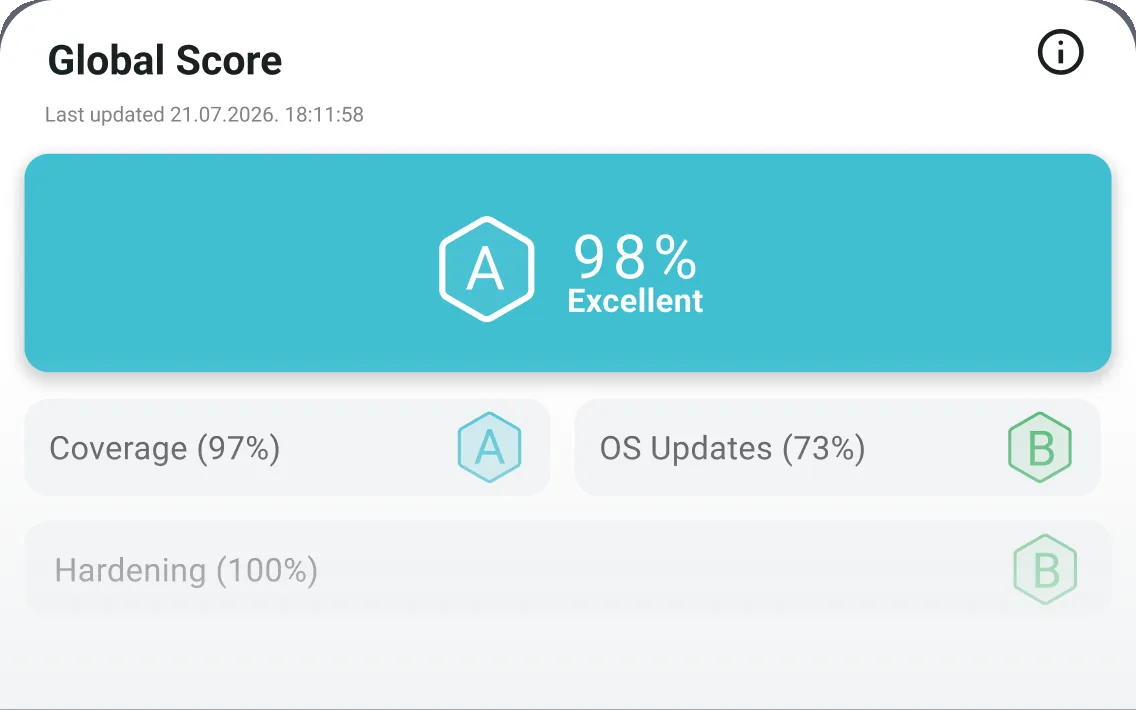
In other words, it turns security into clear metrics that support decision-making and strengthen business operations, such as the percentage of endpoints aligned to a defined baseline configuration, the percentage of devices with active administrative privileges, exposed remote services, and remote access tools detected in the environment.
How to Get Started Without Losing Your Mind?
Simple: start with a real inventory of endpoints, define a reasonable minimum baseline, establish a “Golden Image” level or best practices and standards, eliminate quick high-risk configurations, measure compliance against organizational benchmarks, and automate wherever possible. Don’t aim for perfection—aim for measurable reduction.
Secure by Design vs. Exposed by Design
Attackers automate searches, buy access, and exploit weak configurations. Hardening is about putting the house in order. And that completely changes the risk profile.
Because hardening is not a checklist. It’s a shift in methodology and a new mindset.
Sources of Information
Verizon – Data Breach Investigations Report (DBIR) 2025
https://www.verizon.com/business/resources/reports/dbir
CISA – Known Exploited Vulnerabilities (KEV) Catalog
https://www.cisa.gov/known-exploited-vulnerabilities-catalog
Check Point Research – Latin America Cyber Threat Reports 2025
https://blog.checkpoint.com/category/research
CrowdStrike – LATAM Threat Landscape Report
https://www.crowdstrike.com/blog
Center for Internet Security (CIS) – CIS Benchmarks
https://www.cisecurity.org/cis-benchmarks
Reporte sobre fraude digital en México (El País, 2025)
Industrial Cyber – Latin America Ransomware Trends 2025
Related content
The Compliance Illusion: Compliance Does Not Mean Security
Passing an audit doesn't mean you're secure. Compliance is a snapshot; security is a living state that shifts every day. This post…
Why the endpoint remains the center of everything
Most security paths still end at the endpoint. Yet protection rarely starts with detection—it starts with control. This post explains why endpoint…
What You Should Really Measure in Cybersecurity (and What You Shouldn’t)
Having more alerts, dashboards, or tools does not mean having less risk. This post breaks down why most security posture metrics measure…